
Robert Mapplethorpe - Beauty, Eroticism and the Magic of Simplicity
Sometimes you see a photograph so beautiful that it stops you in your tracks. Not because so much is happening, but because so little is. The shape, the light, the silence. Everything feels right.
That's how I felt when I first discovered Robert Mapplethorpe. I had never seen anything like it. His photographs were breathtakingly beautiful. Almost shockingly so.
What struck me most was their simplicity. A body, a face, a flower. Hardly any distractions. And yet something extraordinary happens. Almost something mystical. As if there is a presence within the photograph that goes beyond the image itself.
I was so fascinated that I wanted to discover for myself how he created that magic. So I started experimenting with his images.
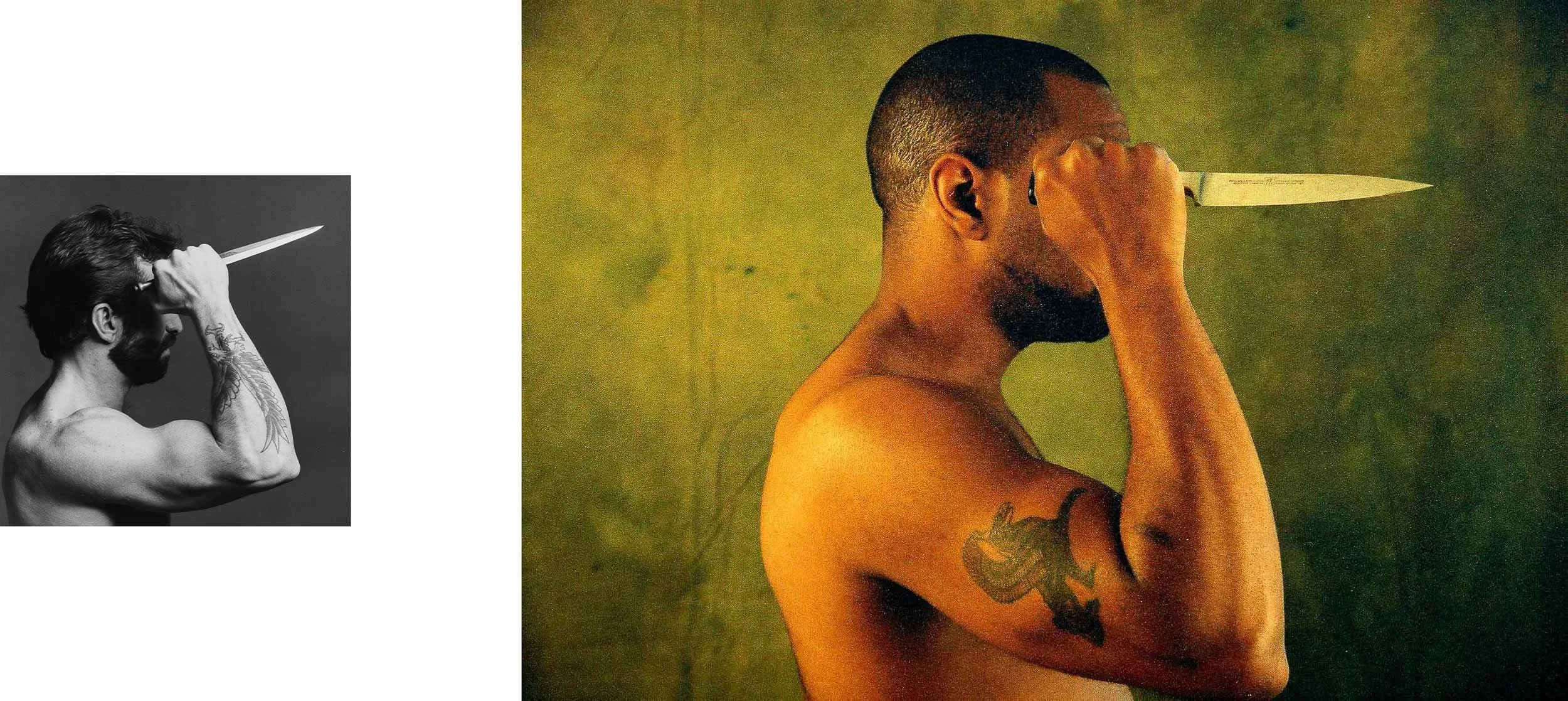
Left: Frank Diaz 1979 by Robert Mapplethorpe Right: Terence 2003 by Harrie de Fotograaf
A discovery that went far beyond photography
I was 22 when I visited a Mapplethorpe exhibition at the Stedelijk Museum in Amsterdam in 1988. I probably didn't understand everything I saw, but I was completely fascinated.
His photographs of Black men made a particularly strong impression. The way light travelled across dark skin, revealing muscles, shapes and textures. I found it extraordinarily beautiful. And erotic, too.
In advertising, I mostly saw beautiful women selling perfume, clothes or household products. None of that really interested me. With Mapplethorpe, I suddenly saw the male body celebrated as an object of pure beauty. And desire.
His photographs could be explicitly sexual, yet remained incredibly controlled, elegant and composed. What others considered provocative, I often found liberating.
I grew up in a liberal, artistic family. My mother and several of my uncles were artists. Nudity itself was never particularly shocking to me. But throughout art history, male sexuality often seems carefully concealed. Classical male nudes frequently have absurdly small penises, as though the real thing might somehow spoil the beauty.
Not with Mapplethorpe.
A penis could simply be a penis. Even a large one. I loved that freedom. The unapologetic celebration of the male body, its strength, its sexuality and its beauty.
And I miss some of that openness today. We seem to have entered a more prudish era again, where powerful, openly dominant male eroticism is quickly labelled inappropriate, provocative or even threatening.
But why? There is nothing inherently wrong with sexual power or desire. Beauty doesn't always have to be modest, restrained or polite.
That's one reason Mapplethorpe still feels so wonderfully refreshing to me.
A photographer I discovered just as he was dying
My introduction to Mapplethorpe happened in three strange stages.
First, I discovered his work in a commercial photography annual. I was immediately hooked. Later, I came across more photographs and learned that he had AIDS. The next time I heard about him, he had died. It all happened so quickly.
Those were the 1980s. I was young, going out in Utrecht and Amsterdam, discovering my sexuality and enjoying it enormously. But AIDS was everywhere. Sex was super exciting, thrilling and wonderful, yet inseparable from enormous fear and the possibility of death.
In 1984, I met my first boyfriend, Jan. We hitchhiked to Israel together with very little money. Our relationship lasted about six months, but we remained very close friends.
In 1992, Jan became seriously ill. He died of AIDS in 1993, aged just 25. I was with him in his apartment when he died. It was devastating. Even now, writing about it is difficult.
And Jan wasn't the only one. Other young men I knew from the gay scene died during those years. It felt as if invisible snipers were everywhere. Every so often, another familiar face would simply disappear from nightlife, leaving us wondering who might be next.
Death was no longer something abstract, it was there. It had become part of our lives, especially when you are a young gay men.
That same year, 1993, I bought a large retrospective book of Mapplethorpe's photography. I began studying his images intensely, trying to understand how he created them.
My fascination also made me want to get closer to the man behind those photographs. I even sought out the Dutch choreographer Hans van Manen many years later, precisely because he had known Mapplethorpe personally. For me, meeting someone who had actually known Robert was a way of getting a little closer to him. I wrote about that encounter.
I also find it fascinating how Mapplethorpe's visual language can be recognised in the work of other artists, including Hans van Manen and Erwin Olaf. That influence reaches far beyond photography.
Perhaps the events of those years help explain why Mapplethorpe's work came to mean so much more to me than beautiful photographs. It brought together beauty, desire, vulnerability and mortality. Almost something religious.
The mystery of his light
That 1993 book is still on my bookshelf. It remains my favourite photography book.
One image fascinated me in particular: Mapplethorpe's 1988 portrait of Sigourney Weaver. Her skin seems to glow. The light is unbelievably soft, yet her face retains its beautiful shape. And strangely, the lighting itself is almost invisible.
How on earth had he done it? I studied the tiny reflections in her pupils, trying to work out where the lights had been placed. I didn't even know the word softbox yet. But I wanted to recreate that light. So I started experimenting.
I was living in a tiny student room in Amsterdam, overlooking the Scheepvaart Museum. I bought two large pieces of white cotton at the Albert Cuyp market and a couple of 500-watt construction lights from a hardware store.
I stretched wires diagonally across my room, hung the cotton sheets with clothes pegs and directed the lamps towards them. The light spread beautifully through the fabric. It worked! Unfortunately, those construction lights generated an enormous amount of heat. My little room quickly turned into a sauna.
Meanwhile, I was also fascinated by Mapplethorpe's portrait of Dennis Speight from 1980. The pose was so wonderfully simple. The body forming an almost perfect oval, the face looking directly at the viewer. I decided to photograph myself in a similar position but using the soft light I had discovered through studying Sigourney Weaver.
An evening in a boiling-hot student room
Sigourney Weaver 1988 by Robert Mapplethorpe Dennis Spreight 1980 by Robert Mapplethorpe Self-Portrait 1993 by Harrie de Fotograaf
This is the result, taken in 1993. I stood on a table, using mirrors on the walls to check my position. The camera was on a tripod, with the self-timer set to ten seconds. I would check my pose, press the shutter, rush back into position and try to remain perfectly still. Ten seconds can feel incredibly long when you're balancing like that. Especially in a student room sauna.
I was shooting black-and-white film on a 35mm camera. Unlike Mapplethorpe, who used medium format, I had to fill the frame as much as possible to retain enough detail. And of course, there was no digital screen to check the result.
Apparently, I took just one photograph. One negative! I must have been remarkably confident!
Looking back, I find it amusing that Dennis's body forms a beautiful oval while mine looks distinctly more square. I was also aware that his dark skin and my pale skin required different lighting and backgrounds. Even my white sports socks were deliberate. Otherwise, my feet would have disappeared into the shadows.
But what mattered most was capturing the simplicity of Dennis's pose and the magical softness of Sigourney Weaver's skin. For the first time, I understood how Mapplethorpe created this light. What a discovery!
Years later, when I became a professional photographer, I bought proper softboxes. I remember how extremely proud I was, like a small child.
But I still love thinking back to that overheated student room, the cotton sheets and the construction lights. I had discovered something for myself!
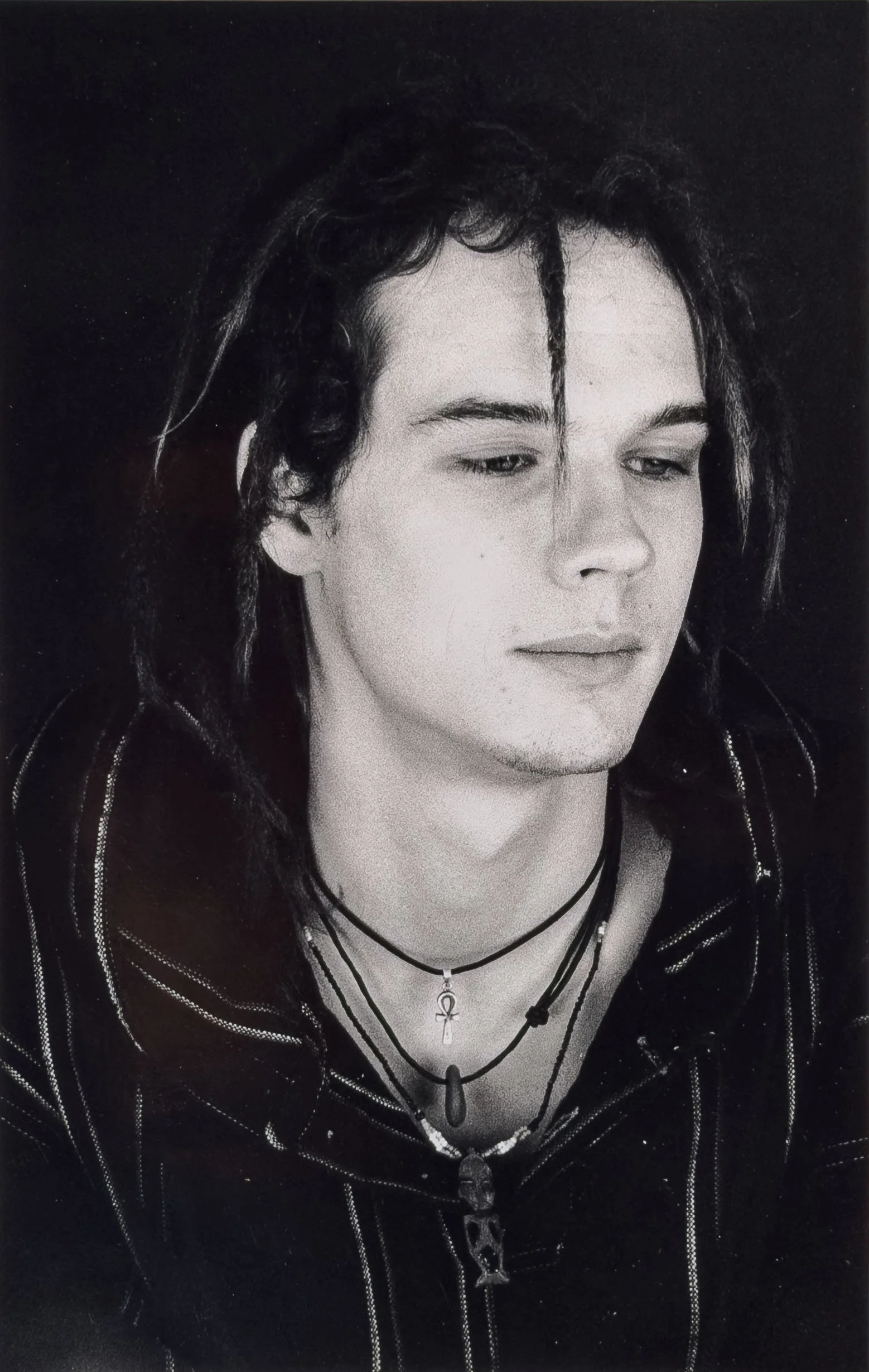
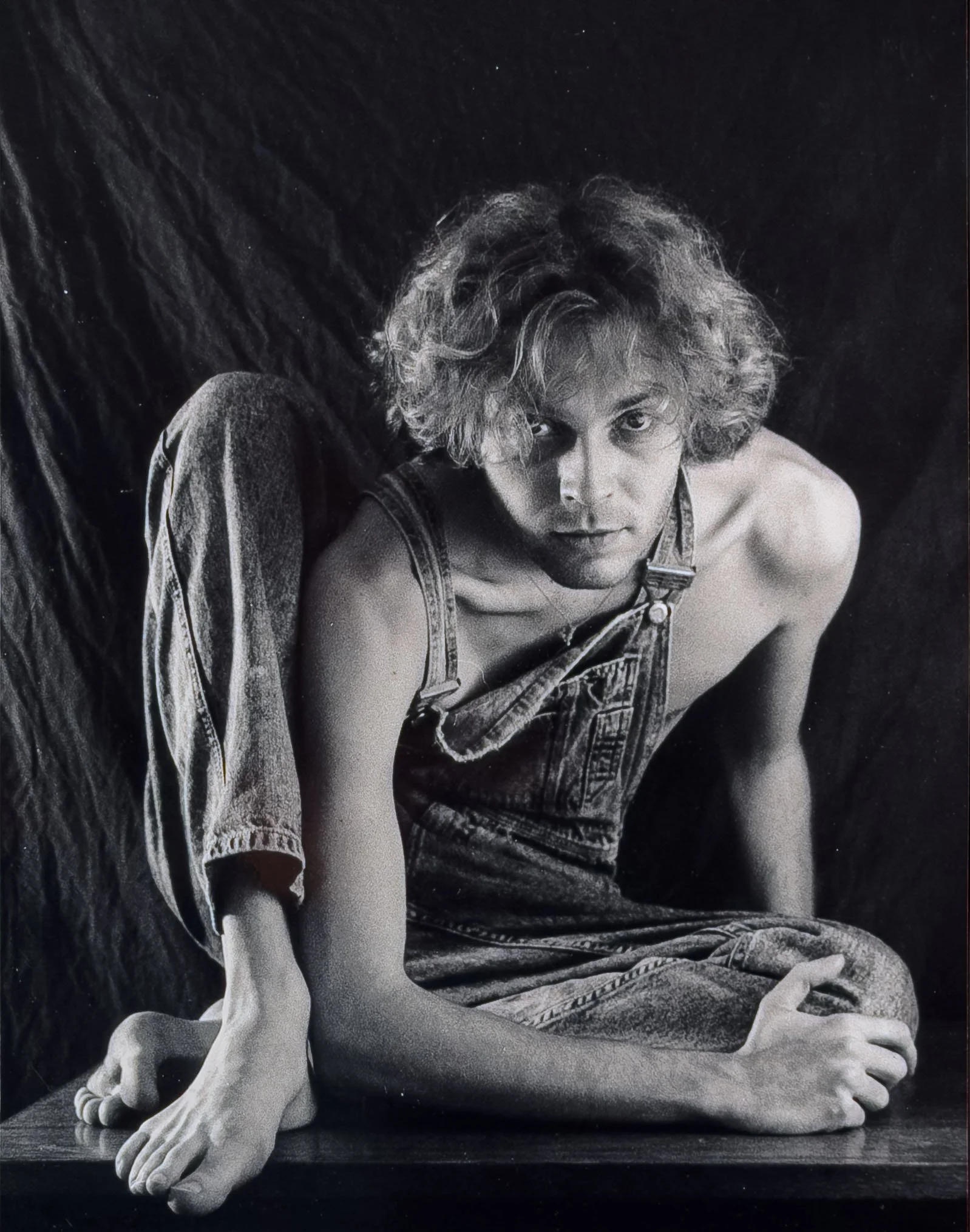
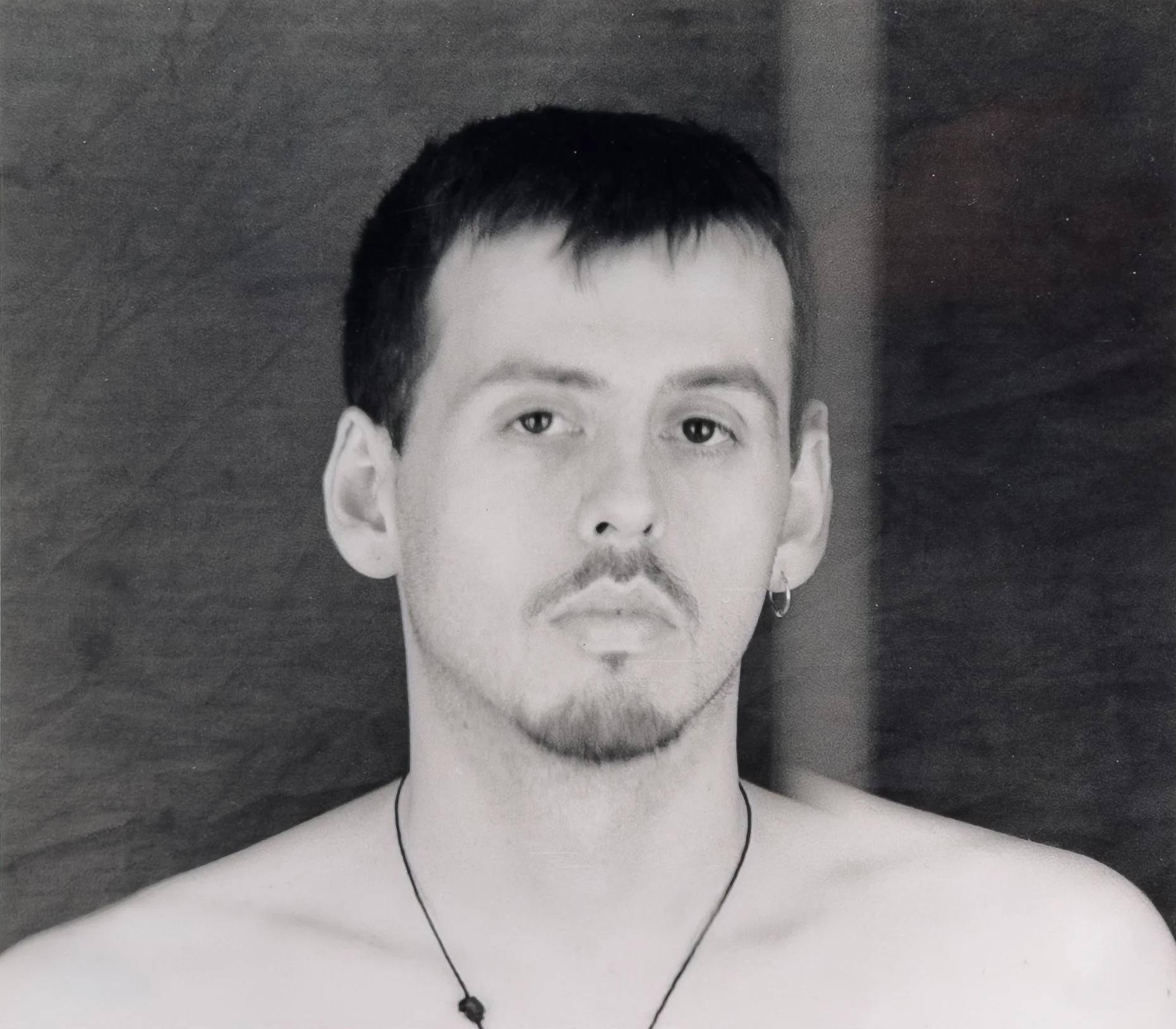
Of course, once I'd discovered that beautiful soft light, I wanted to keep experimenting! Here are three photographs from 1993, featuring two friends (Kwinten and Sander) from my student house and myself via the mirrors. All inspired by Mapplethorpe, and all made with my homemade lighting setup. So yes, sauna again and again!
From imitation to something personal
What I love about studying other photographers is that trying to recreate an image forces you to understand the choices behind it. Why that crop? Why that light? Why that particular pose?
You begin with admiration, but eventually you have to make your own decisions. And sometimes the result becomes something entirely different. I even recreated his famous photograph of a bunch of grapes, exploring how something so ordinary could become extraordinarily beautiful. That experiment deserves a story of its own, which I'll share another time.
One example is Mapplethorpe's famous self-portrait from 1988, in which he leans on a walking stick topped with a small skull. His face almost disappears into darkness. The skull is sharply defined, while Mapplethorpe looks out from the shadows. He knew he was dying.
In 2004, I created my own interpretation.
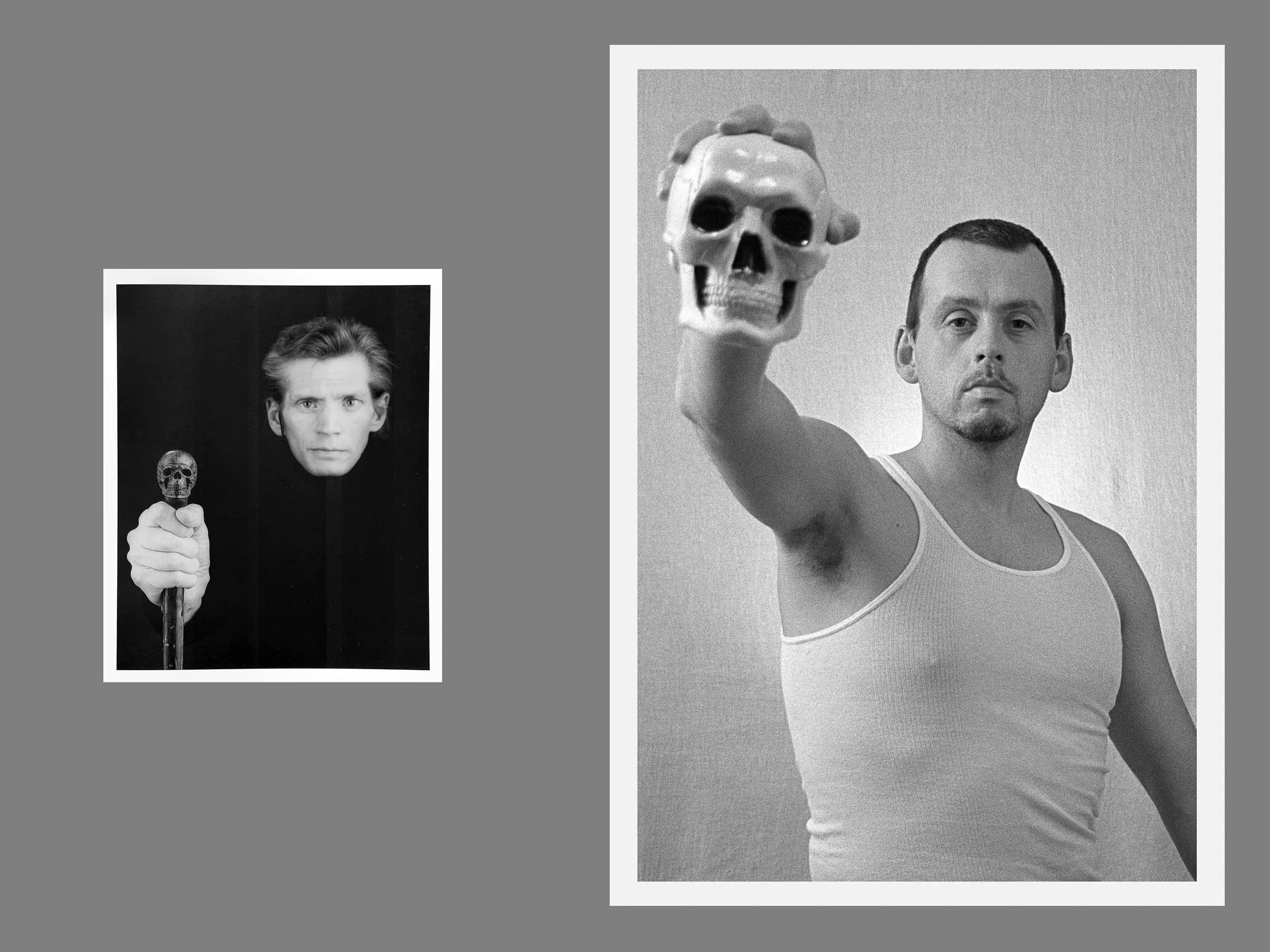
Left: Self-Portrait 1988 by Robert Mapplethorpe Right: Self-Portrait 2004 by Harrie de Fotograaf
The two images share similar elements: a man, a skull, an outstretched arm. But to me, they tell completely different stories. Mapplethorpe's portrait is about approaching death. Mine is about life. Survival. Triumph. I stand upright in a white shirt, looking directly at the viewer. My face is sharp, not the skull. I hold it almost defiantly, rather than leaning on it. I would have loved to use a real human skull, but couldn't find one in those days, so a plastic skull had to do.
What fascinates me is how the same visual idea can express almost opposite meanings. Light, focus, pose and composition change everything. That's the magic of photography.
Beauty and the sacred
There is another quality in Mapplethorpe's work that has always fascinated me: its almost religious atmosphere.
I'm not religious in the traditional sense, and neither was Mapplethorpe. Yet I can experience something profoundly spiritual in sexuality and beauty. Sometimes desire seems connected to something much greater than ourselves.
I recognise that quality in Mapplethorpe's photographs. They often possess an almost sacred stillness. As if you're looking at more than a body, a flower or an object. As if something is present that cannot quite be explained. Perhaps that's what moves me so much. Through light, form and attention, the photographer creates an image that seems to hold a presence not quite of this world. I don't know exactly what that more is. And perhaps I don't need to.
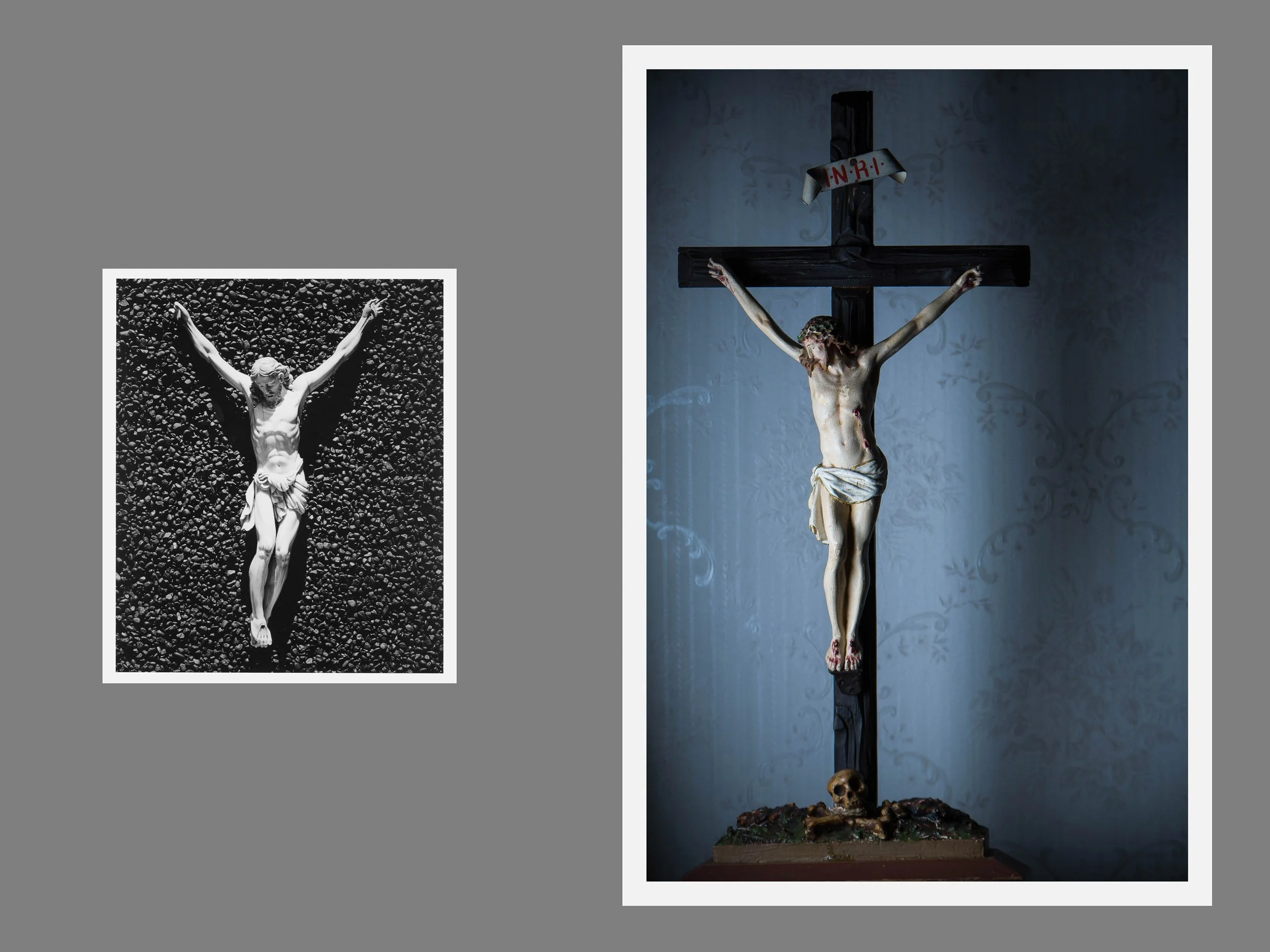
Left: Christ 1988 by Robert Mapplethorpe Right: Christ 2009 by Harrie de Fotograaf
Mapplethorpe's photograph of Christ from 1988 touches a bit on that same fascination. Years later, I photographed a crucifix myself. Not to imitate Mapplethorpe, but because of a similar fascination with form, silence and the strange intensity an image can possess.
What Mapplethorpe gave me
Over the years, I've created more photographs in which his influence can be seen. Sometimes directly, sometimes almost invisibly.
A self-portrait from 2006, inspired by my thoughts about religion and identity following the murder of Theo van Gogh, deserves a story of its own.
But everything eventually brings me back to what I love most about Mapplethorpe. His extraordinary simplicity. His photographs can be erotic, confrontational, moving or spiritual. Yet sometimes almost nothing happens in the frame. And still, the image can completely blow you away.
I've learned a great deal from studying his work, sometimes even trying to recreate it. Especially how light can transform a body, and how the smallest change in pose or composition can change the entire meaning of a photograph.
But perhaps the most important thing he taught me is something I still find difficult to explain. That beauty can be so intense it almost becomes sacred. As if something exists within the image that the photographer didn't consciously invent, but somehow managed to make possible.
I've been working as a professional photographer for many years now. My subjects have changed, and so have my cameras. But my fascination with simplicity, light and beauty has never faded.
And when I open that old Mapplethorpe book today, it still happens. Some photographs are just so beautiful that they leave me completely speechless. What an extraordinary photographer.